Home / The combine-or-split worksheet
The combine-or-split worksheet
One decision, three overriding tags, two paid pre-checks, and a calculator for your own rates.
The worksheet itself
Everything in the warehouse can be combined freely or shipped in batches, and the system estimates packed weight and volume for whatever you tick (article 10057). The two columns below are the whole decision.
Rides in the shared box
- Anything already Stocked in with no restriction tag: the Warehouse page lets you tick it into the same submission, and the system shows an estimated packed weight and volume for the lot (article 10057).
- Soft goods in quantity: the packing standard allows cutting donor boxes down and filling gaps, which is exactly what tees, hoodies and rolled sweatpants are for (article 10062).
- Liquids and medicines, but only up to roughly a tenth of the items in the box, the operator's own recommended ceiling (article 10058).
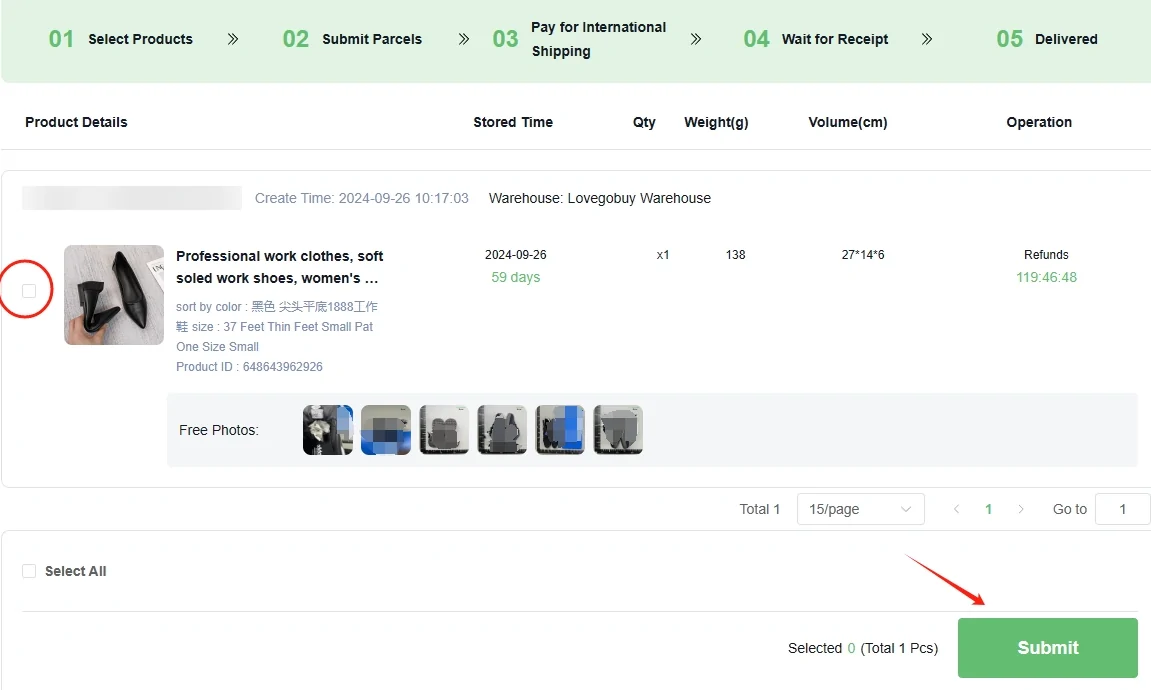
Combining spends one first-weight charge and one handling fee on the whole lot.
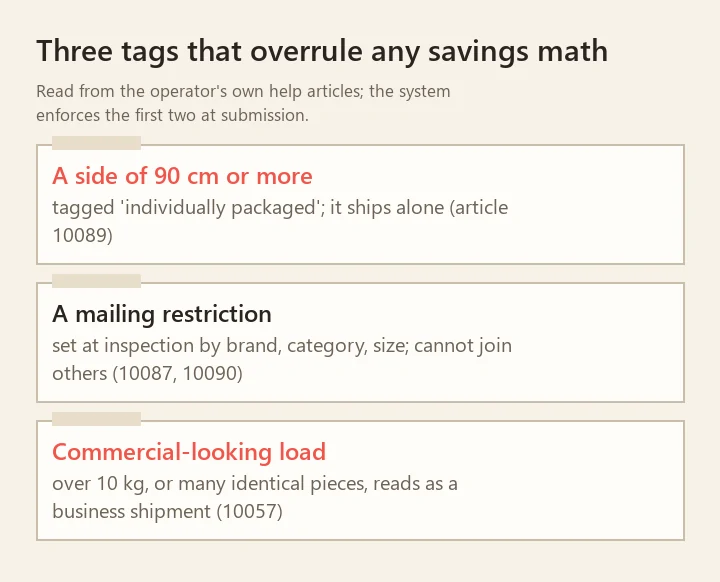
Forces its own parcel
- A side of 90 cm or more. The system tags the item "individually packaged" and will not let it join a combined submission (article 10089).
- A mailing restriction. Set by inspectors at stock-in based on brand, category and size; restricted items cannot be submitted with others (articles 10087 and 10090).
- Commercial-looking weight or repetition. Over 10 kg, or many identical pieces, raises the odds customs reads the box as a commercial shipment (article 10057).
Ask the agent whether the goods can share a route, then compare the full costs. Splitting is not automatically cheaper.
The operator's own math
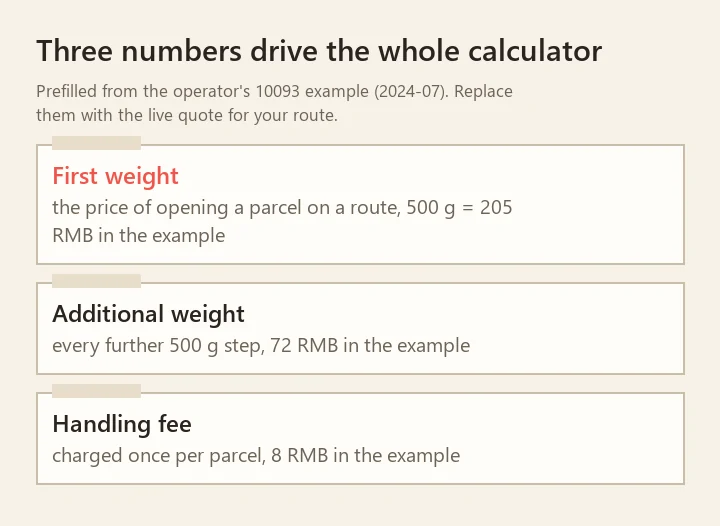
Help article 10093 runs the numbers on GD-EMS to the USA with 2024-07 example rates: first 500 g at 205 RMB, each further 500 g at 72 RMB, 8 RMB handling per parcel. Three finds of 700, 1,100 and 1,600 grams come to 1,071 RMB as three parcels and 645 RMB as one. The article's own closing line prices the gap at 426 RMB.
One care note: the article's intermediate line misprints the combined total as 672, but its own subtraction, 1,071 minus 645 equals 426, pins the correct figure. The numbers above recompute cleanly from its stated rates.
Volume is the half most people skip
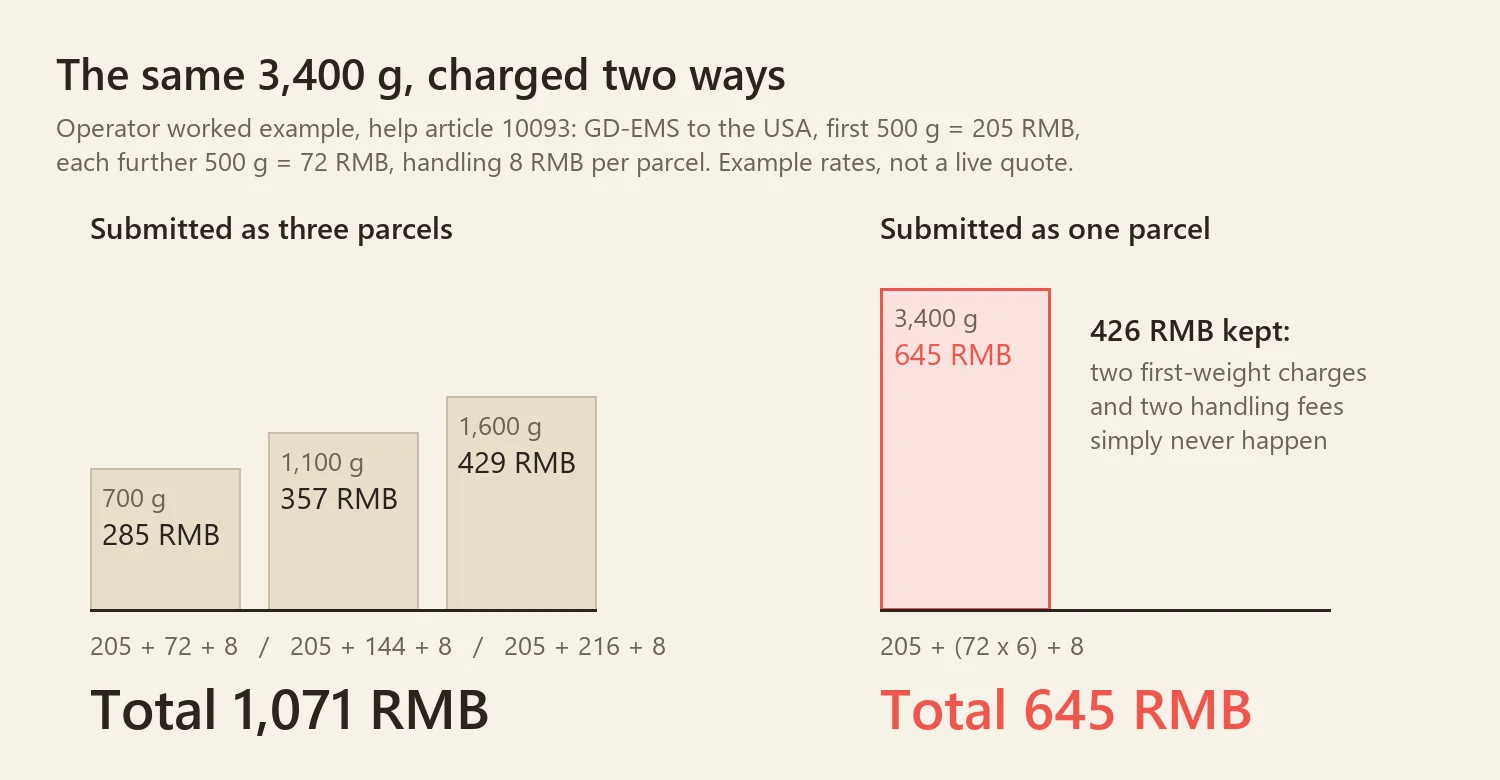
Billing takes the larger of actual and volumetric weight, and volumetric weight is length times width times height over a divisor the route chooses (article 10091). In the operator's US list read on 2026-10-10, three divisors appear: 6000 on GD-EMS once a side reaches 60 cm, 7000 on UK-RoyalMail, 8000 on Love-EU Electronic and DPD.
That is why combining is a volume question and not a count question: five flat tees change a box's billed weight barely at all, while one rigid sneaker box can tip a divisor-billed route past the next 500-gram step.
What the system tells you before you pay
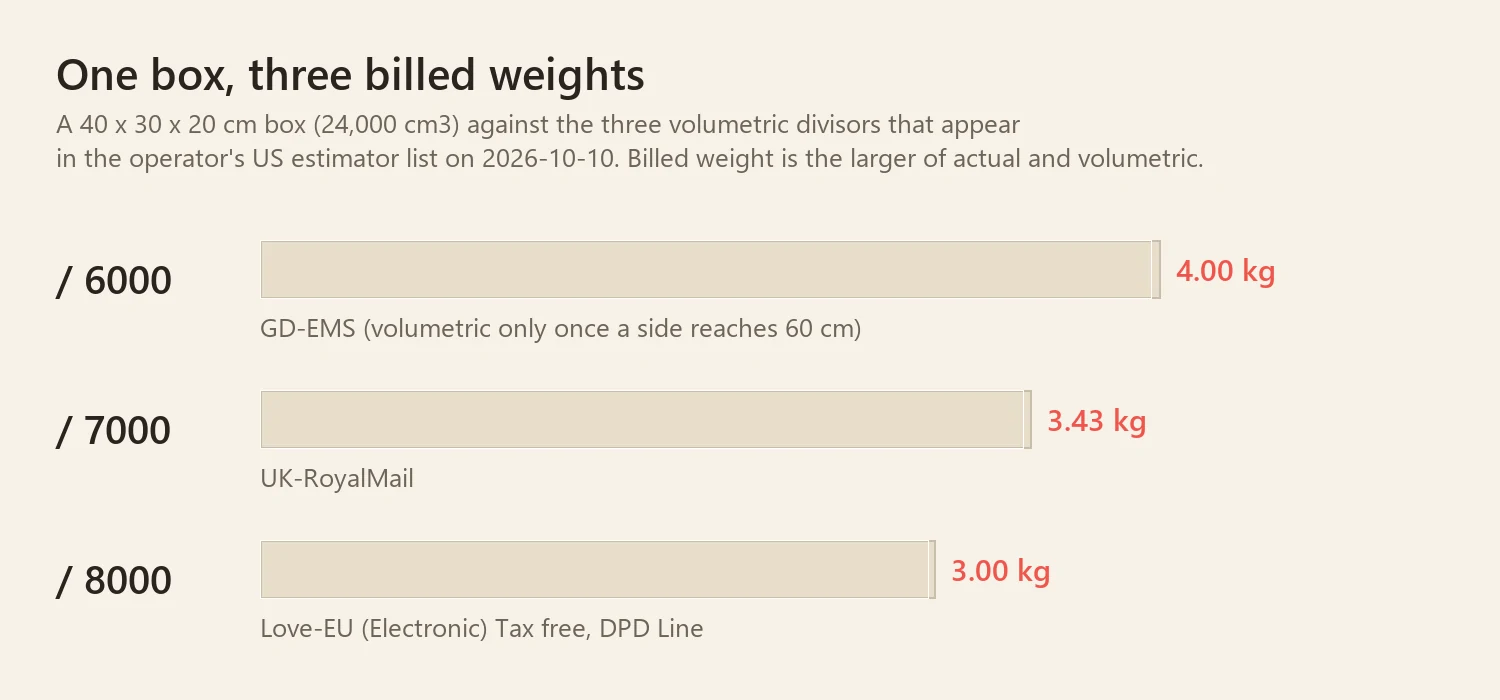
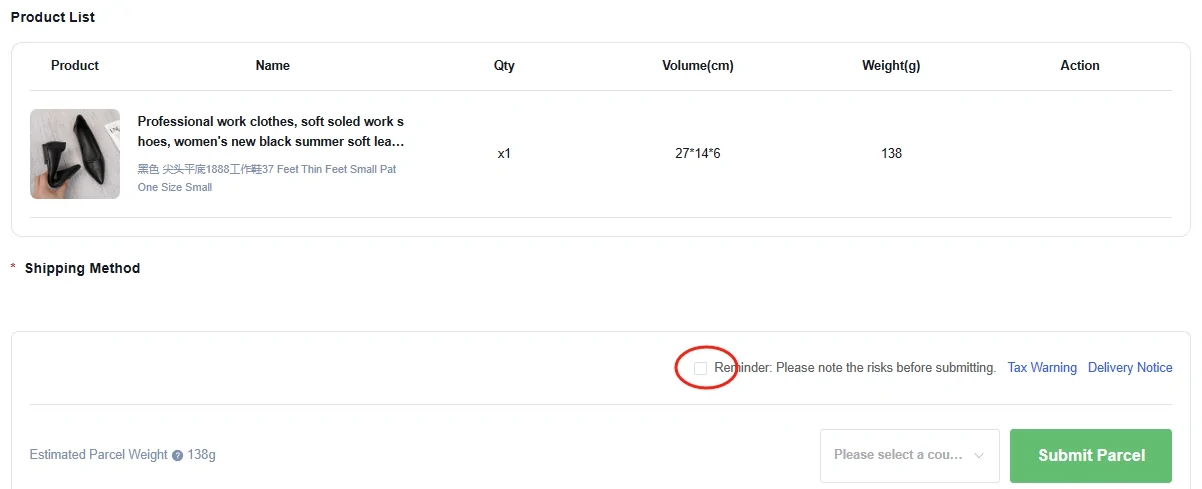
At submission the system shows an estimated parcel weight, built from the stored weight of each item plus a packing allowance: the 2024-09 frame below reads 'Estimated Parcel Weight 138g' for a single pair of shoes stored at 27 x 14 x 6 cm.
The warehouse scale has the final word. If the estimate overcharged you, the difference returns to balance within 72 hours of dispatch; if it undercharged, a pending payment appears (article 10092). Combining does not change that mechanism, it just means one reconciliation instead of several.
The calculator, fed with your rates
This tool reruns the 10093 arithmetic on any route: give it the three numbers from the official estimate for your destination, list your item weights, and it prices every-parcel-separate against one-combined-parcel. The prefilled values are the 2024-07 example rates, there to show the shape of an answer, not to be believed.
Results appear here: separate total, combined total, and the difference.
Reading the answer like the warehouse does
The calculator flags a combined load over 10 kg, because weight and repeated items are exactly what customs uses to call a parcel commercial (article 10057). It cannot see dimensions, so pair its verdict with the line caps table, and when the answer is close, 20 RMB of Rehearsal Packing buys you the real packed weight before you commit (article 10098).